10.28.2012

Is Asia energy demand recovering?

Crude oil market is under the pressure currently because bearish forecasts about the global economy give negative prediction to the energy consumption.
However, recent data on Asian oil demand show some recovery. It seems to suggest that the growth of regional energy use is bottoming out.

India's crude oil throughput in September rose 11.4% from a year ago to 3.45 million barrels per day, according to the Ministry of Petroleum and Natural Gas. It was the biggest year-on-year growth since July 2010.


Chinese crude oil throughput also soared by 7.0% on year to 9.47 million bpd in September, according to the National Bureau of Statistics. The nation's growth rates of crude oil processing had been less than 2% or negative figures over the past several months.

Japan has recorded year-on-year decrease of crude oil throughput during July and September, but weekly data by the Petroleum Association of Japan show 1.3% gains in the first 20 days in October.

Petroleum data describe that Asian demand is rebounding from the previous downward tendency. But we need to see another key data, electricity output.

Indian electricity output in September rose 3.7% on year to 73.1 billion kilowatt-hour, according to the Ministry of Power. Only India continues positive growth of monthly power generation among Asian three large countries over the past few years.

Meanwhile, China's electricity generation in September stood at only 1.2% growth, and Japan's power output fell 0.4% on year in the month due to the nationwide power saving following the nuclear power outage.


The growth of electricity generation seems to remain in the slow down tendency.
The Indian higher crude oil demand was likely caused by on-site generation to make up for a lack of electricity supply. China's increased crude oil processing in September might be related to the raise of domestic official petroleum prices. Lower products stock caused by dealers' hoarding before price increase and better refinery margins encouraged Chinese refiners to increase their operating rates.

We may have to wait an another 2-3 months before confirming whether Asian energy demand has finished the weak trend.

10.22.2012

NYMEX to become more local oil market

Brent's premium to WTI prices is increasing. Since NYMEX WTI crude oil prices are losing close relationship with global situations, NYMEX seems to be going to become a more local market.

The WTI crude oil prices should be higher than Brent due to its high grade, however, the American standard prices have been usually cheaper than Brent over the past couple of years.

Crude oil stocks at Cushing, Oklahoma used to have major impact to WTI crude oil prices, because NYMEX crude oil futures contracts are finally settled by physical delivery at Cushing. It has made some people to doubt the WTI's validity as an indicator price.

Therefore, some market participants recently use brent prices as the market indicator rather than WTI. Investment banks are also using Brent prices for their price forecasts.


The Brent/WTI price difference had close correlation with Cushing crude oil stocks until 2009, but the relationship has significantly changed in 2011.

Tensions in Middle East has been the major factor to decide the price differentials rather than the US inventories. Arabian Spring and Libyan civil war widen the Brent/WTI prices last year, then Iran's nuclear program and Syria-Turkey tension are supporting the recent steady premium.

On the other hand, Cushing crude oil inventory became to be able to carry to the Gulf of Mexico area after beginning of the reverse operations at the Seaway pipeline in May this year. The US Midwest crude stocks are no longer to be dead-end.

The Brent/WTI differential previously had been affected by the US domestic inventory level, but now it is largely swayed by the Middle Eastern geopolitical situation.


Middle Eastern tension is losing its influence to the United States because the US reduces crude oil imports due to increasing domestic production.
Meanwhile, the Middle Eastern situation that stimulates the Brent market also affects on Asian nations' crude oil imports significantly.

Brent prices' reaction against the Middle East tension seems not excessive, rather it is more critical that WTI prices are weakening relationship with international affairs.

10.14.2012

China's energy use shows further slump in September

Chinese September energy related economic statistics are showing slump.

China's crude oil import in September fell 2.2% from a year ago to 20 million tonnes or 4.9 million barrels per day, according to the General Administration of Customs. It was an another year-on-year decrease following August.


China was estimated increasing extra crude oil to fill the new strategic petroleum reserve facilities during the first half of this year. After completing the stockpile, crude oil imports for real demand show such sluggish figures.

Crude oil imports in the China in the first nine months rose 5.5% on year to 200 million tonnes, according to the customs data. However, the growth rate would be only 0.6%, if deduct the 80 millions barrel of strategic reserve amount from the total number.

On the other hand, State Electricity Regulatory Commission announced that China's electricity supply in September was 394.5 billion kilowatt-hour, rose only 2.2% from a year earlier.

The SERC's data showed the country's power supply increased 5.5% during first 6 months in this year to 2.37 trillion kWh, then rose 4.5% on year to 45.4 billion kWh in July and up 3.6% from a year ago to 44.5 billion kWh in August.

China's year-on-year growth of power supply was two digits last year. The growth of the electricity demand is apparently slowing down month by month.

Meanwhile, the sluggish tendency did not accelerate in September. It suggests the nationwide anti-Japan campaign did not affect entire Chinese industry significantly.

10.07.2012

Dull exports lead China firms compete in limited local market

Chinese government recently announced to encourage exporting firms to develop domestic sales channel due to slump of processing trade activities.
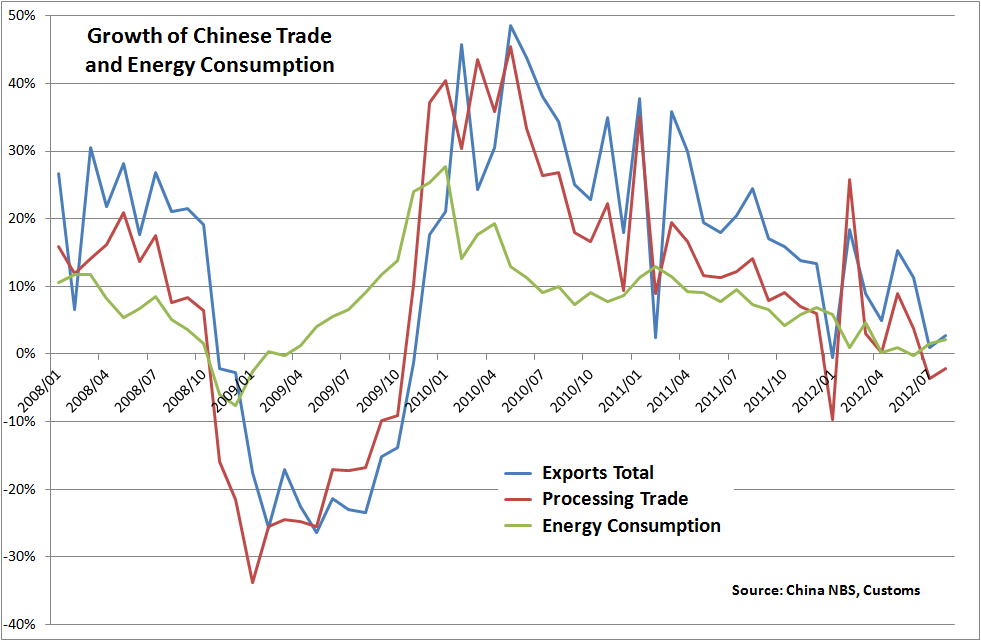
However, current energy consumption figures in China suggest that the domestic market is not enough active to absorb supply from exporting companies.

Chinese processing trade companies are located in the bonded area. They import parts and materials from overseas without tariff, and their products are basically exported. Those companies have contributed China to earn huge amount of foreign currencies since the reform and open policy.
Processing trade companies should be licensed from the government when they wish to sell their products directly into the domestic market.

Chinese government deregulated the rule of domestic sales license for part of excellent processing trade firms in 2009 following the severe slump of exports due to the Lehman shock. This time, general processing trade companies are also encouraged to develop domestic markets.

China's processing trade amounts were 112.6 billion US dollars in August, according to the General Administration of Customs. It was 2.2% lower than the same month a year ago. Processing trade had already recorded year-on-year decrease in July.


Chinese processing trade had grown by two digits except for the slump period after the Lehman shock, but the growth rate has faded since 3Q 2011 after the Chinese yuan became stronger than the $1=6.4 yuan level.

Japan's exports, that is the typical supply source for the Chinese processing trade, also peaked out in late 2010. Although Japanese exports had strongly correlated with Chinese exports, those two numbers has been deviating especially after the Japan's severe earthquake in March 2011.

While growth of processing trade is fading, China's total exports continue moderate growth due to the relatively firmer general trades. Some people believe that the growth of general trades suggests that Chinese industrial activities are shifting from the subcontract of foreign companies to mature local industry. Those people anticipate consumption of the domestic Chinese people is also growing.


However, the growth of energy consumption apparently shows actual slowdown of industrial activities in China. Growth of exports including the general trades is also under the shrinking tendency.
If Chinese domestic demand is expanding despite the sluggish growth of exports, energy consumption is likely to maintain steady growth. Therefore, it is natural to think the Chinese domestic demand is not strong enough at moment.

If many exporting companies rush into the limited domestic markets, intense competition with local firms might hurt strength of the entire Chinese manufacturers.

9.30.2012

Disputes not affect Sino-Japan trades?

Because the dispute between China and Japan over the Senkaku islands in East China Sea, many people have concerned about regional trade activities. Daiwa Institute of Research recently announced a report saying the dispute is likely to reduce Japan's exports to China this year by about 1 trillion yen ($12.8 billion).

However, Japanese exports to China has decreased from a year ago level since 2Q 2011. Accumulated amounts in the first eight months in this year fell 9.2% from the same period a year earlier. Japan's exports to China in 2012 are likely to loose more than 1 trillion yen from the previous year even if there is no friction.

If Daiwa Institute predicts that the disputes cause another 1 trillion yen of reduction adding to the original decrease over the past year, Japan's exports to China will fall 16% from a year ago in 2012.
Japan is mainly exporting materials, parts and machineries to China to support Chinese industrial activities. Therefore, the 16% decrease of supply from Japan will cause significant limitation over Chinese manufacturing.

China seems to try to hide its rapid decrease of demand for materials and machineries using the friction with Japan.

The below chart shows the monthly year-on-year changes of China's energy demand and Japan's exports to China.


Growth of petroleum demand has been sluggish since the latter half of last year, and growth of electricity demand has been approaching to zero.
Since the slowdown of energy consumption represents sluggish manufacturing activities, demand for Japanese materials and parts is also declining.

The apparent oil demand, which is thought as the Chinese domestic pure demand calculated by Platts, shows more clear tendency of lowered growth of Chinese petroleum demand.


China's crude oil imports seemed to keep upward trend until mid-2012, but the import figures in the first half of this year contained stockpile for the newly build 80 million barrels of strategic reserve facilities.
Then, imports in July and August decreased apparently, and suggest fewer crude oil processing in the following months.

Even if both nations didn't have frictions, Japan's exports to China could have been likely to drop sharply after September.

9.23.2012

Can we believe recovery of Iranian oil exports?

Recently, crude oil exports from Iran are reported to rebound. Is it meaning a change of situation?

Iran's crude oil exports have decreased significantly since July when sanctions by the European Union were invoked. The sanctions inhibit European nations to import Iranian crude oil and do not allow European insurance companies to underwrite marine insurance for tankers that carry Iranian crude oil toward any regions. Therefore, Iran's crude oil export was estimated to decline below the 1 million barrels per day level in July from above 2 million bpd level.

However, some alternatives against insurance by European companies are said to re-activate Iranian crude oil export.

Japan and India have decided to set the sovereign insurance for tankers to import Iranian crude oil. Although Japan's Iranian crude oil imports recorded zero in July, it seems to resume in August.

South Korea, which ceased to buy Iranian crude oil in July, also resumed purchase in September. The country uses insurance provided by Iran.
Marine insurance provided by Iran seems to recall some buyers who were worry about the risk on uninsured transportation.

On the other hand, It is expected that financial sanctions by the United States to deter buyers expansion of Iranian crude oil imports.
The U.S. has decided to sanction against financial institutes of countries that trade with Iran. But the sanction can be exempted for 6 month if the country reduce crude oil imports from Iran significantly.

Japan was approved the first exemption in March and another 6 months extension was given in September.
Meanwhile, China and India won the first exemption in June and another 6 months extension could be decided by the end of December.
It is unclear whether the U.S. will give these nations another exemption or not if they resume large Iranian oil imports.

About China, there is an another concern whether the country needs further Iranian oil or not.
China imported average 560,000 bpd of Iranian crude oil in 2011. But the numbers declined to about 350,000 bpd in the first quarter this year due to conflict over price negotiation.

Although the nation's Iranian oil imports rebounded to 520,000 bpd in the second quarter, decreased again to 460,000 bpd in July and 370,000 bpd in August. The August figure fell 22% from a year ago.

The decline in the third quarter was not only affected by the insurance problem, but also was caused by the sluggish demand.
China's total crude oil imports in August decreased 12.5% on year to 4.35 million bpd. It was the lowest level since October 2010.

China's accumulated crude oil imports during the first eight months in 2012 rose 7.4% from a year ago to 180 million tonnes. However, China has completed construction of 80 million barrels of national petroleum reserve facilities in early this year and started filling.

If the stockpile oil is deducted from total imports, net crude oil imports by China rose by only 0.7% on year in the Jan-Aug period. The real import number is match with the fact that the growth rate of crude oil processing during January and August stayed at 1.6% on year and the domestic crude oil production in the same period fell 0.4% from a year ago.

Then, recent economic data suggest that the growth of Chinese crude oil demand is likely to shrink further. China seems not necessary to buy more Iranian crude oil in spite of the risk of suffering financial sanctions.

9.16.2012

Mideast tensions rather to stabilize crude oil supply

Many market participants are afraid about that tensions in the middle east caused by anti-Islam film may threaten crude oil supply.
Does the turmoil actually affect on crude oil supply seriously?

Libyan civil war caused crude oil supply disruption last year. The war cut the country's crude oil production from the previous 1.6 million barrels per day to zero. WTI crude oil prices surged from around $80/bbl to above $110/bbl following the disruption.


Libyan crude oil output, however, rebounded rapidly after the cease of the civil war. Although battles spread over whole countries, damages on oil related facilities were much smaller than expected.

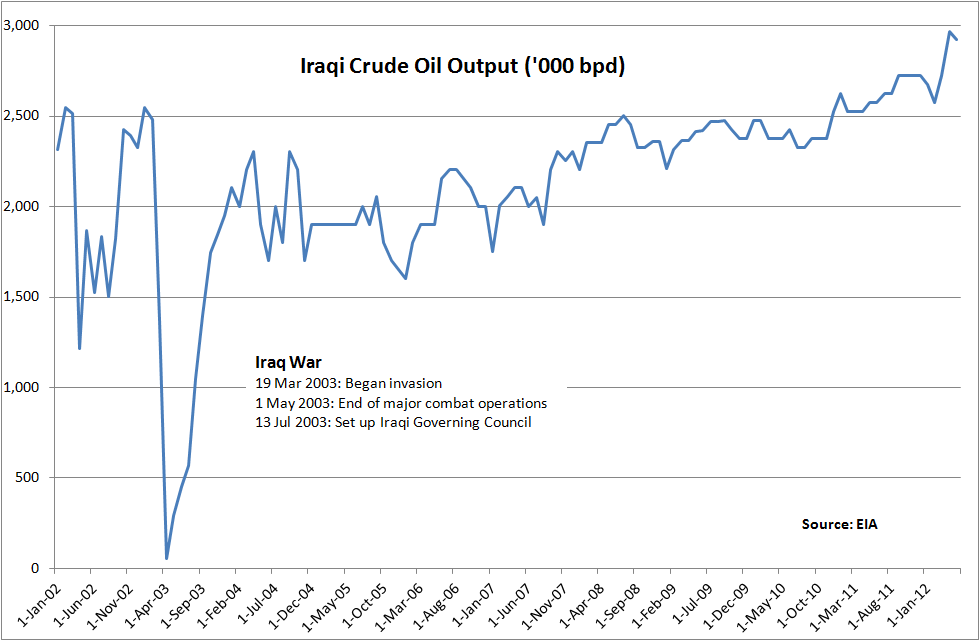
Similar situations were seen during the Iraq War a decade ago. Crude oil production resumed immediately after the end of major combat operations. Iraqi crude oil production recovered the nearly same level with pre-war level within less than half year despite continuing minor battles in the nation.


Why severe supply disruption can be caused by demonstrations and riots in urban areas, despite oil output facilities are not damaged even during war?

Political stability of countries being democratized by the Arab Spring movements in last year has been lowered. Combined governments are easy to be affected by extremists. It is difficult for those governments to control turmoil.

Demonstrations for democratization were seen even in Persian Gulf oil producing nations, and protest activities against the anti-Islam film also occur there.

But unstable situations in Libya and Egypt and the dire situation in Syria, where turmoil and civil war have continued since early last year without intervention by international society, seem to calm down people's enthusiasm against democracy in Arab oil producing countries such as Saudi Arabia.

Democratization does not bring better results,  people are likely to recognize that it causes deteriorated public security and spread of terrorism.
Therefore, current turmoil in the middle east may suppress democratization movements in regional oil producing countries. It seems to stabilize crude oil supply from the area as a result.